

Hiring a professional is supposed to remove some of the uncertainty from a home project. You are paying someone who knows the work, knows what materials cost, and presumably has a much better idea than you do of what the job will involve.
Yet the budget can still go wrong.
According to Angi’s 2026 spending research, 43% of homeowners who had recently hired a professional finished above their original estimate.
An extraordinary 92% finished either at or above budget. The survey covered 1,000 U.S. homeowners who had hired a professional for an improvement, repair, or maintenance project during the previous 12 months.
The same research also found that home repairs were more common than renovations during the previous month, at 58% versus 35%.
I think homeowners should pay particular attention to the words hired a professional.
Paying someone to do the work certainly transfers some responsibilities away from you. It does not transfer all of the financial uncertainty.
That distinction is very important; in fact, it is much more important than it sounds.
Hiring a Pro Does Not Turn an Estimate Into a Guarantee

One misunderstanding I have seen repeatedly is the assumption that a professional estimate represents something close to the final price.
Sometimes it does. Sometimes it represents the best price anyone can reasonably calculate before work starts. Those are different things.
A contractor can measure the room, price the cabinets, estimate labor, and account for demolition.
What that contractor cannot necessarily see is damaged framing behind drywall, an electrical system that needs additional work, deteriorated plumbing beneath the floor, or some creative repair performed by a previous owner 25 years ago.
I spent enough years walking through houses to develop considerable respect for what cannot be seen.
Professional expertise helps identify risks. It does not make walls transparent.
That is why I would never hire a contractor and mentally convert the estimate into a guaranteed ceiling unless the contract specifically makes it one.
Nearly Everyone Renovating Already Uses Professionals
There is another reason the Angi figure deserves some context.
Professional involvement in home renovation is already extremely common.
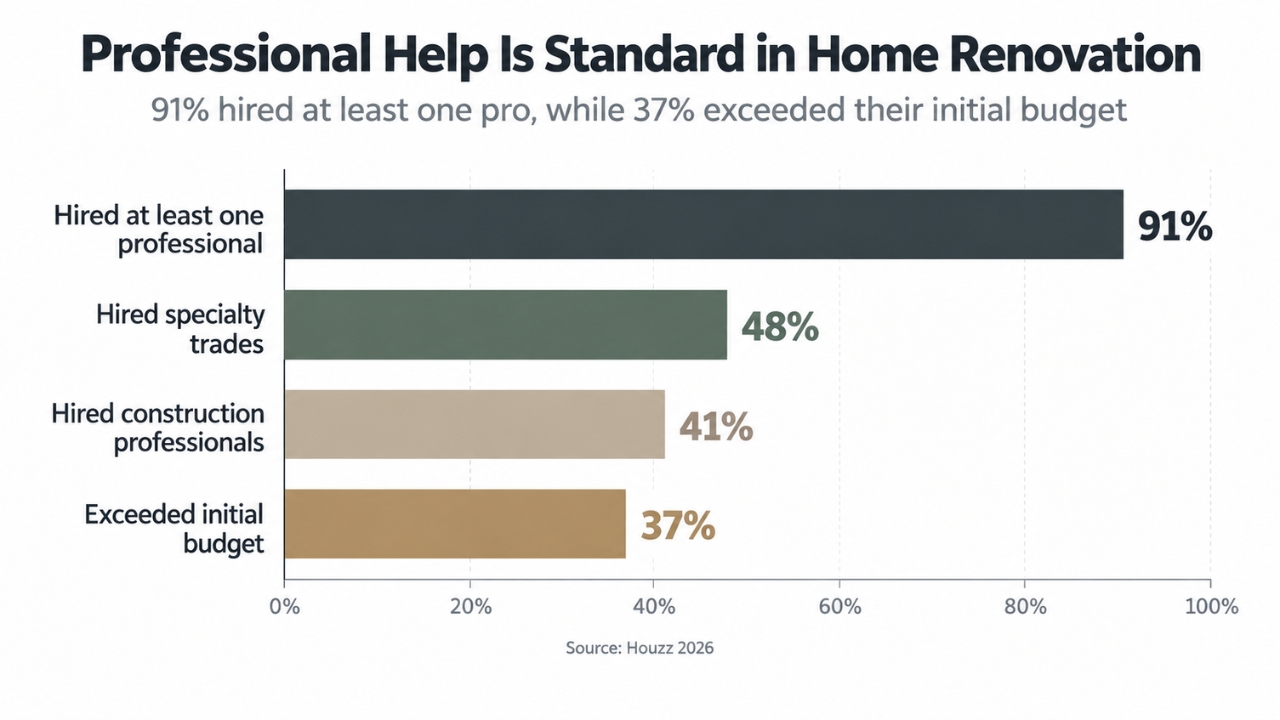
Houzz found that 91% of homeowners renovating in 2025 hired at least one professional. Its 2026 remodeling trends also show that specialty trades such as plumbers, electricians, HVAC professionals, painters, and carpenters were used by 48%, while 41% hired construction professionals such as general contractors, builders, and design-build firms.
At the same time, 37% of renovating homeowners exceeded their initial budgets, according to the Houzz & Home Study.
I would not interpret those two numbers to mean professionals cause overruns. Quite the opposite in many cases.
People generally bring in professionals precisely because the work is too complicated, technical, or substantial to handle themselves.
The more useful conclusion is that professional involvement does not eliminate the forces that push budgets higher.
A good contractor can manage a complicated project.
The contractor cannot make the project uncomplicated.
You Are Paying for Expertise
I think homeowners sometimes expect too much from the estimating process because the estimate comes from someone who does this work every day.
Expertise should improve the estimate. It should identify obvious omissions, realistic labor requirements, material quantities, and likely trouble areas. It should also help prevent expensive mistakes.
Still, some uncertainty belongs to the building itself.
Imagine a contractor prices a bathroom renovation at $28,000 based on everything visible before demolition. Once the floor comes up, water damage extends much farther than anyone expected.
If the damage includes mold, the homeowner may face another expense. Insurance coverage for hidden mold depends on the cause of the moisture and the policy’s exclusions.
Was the original estimate bad? Possibly not.
The real question is whether the contractor could reasonably have known about the damage beforehand.
That is how I would judge an overrun. Not every higher final bill represents poor estimating, just as not every higher bill deserves to be excused as an “unexpected problem.”
Homeowners need to know the difference.
A Professional Estimate Should Tell You More Than the Total
The bottom-line number naturally gets most of the attention. I would pay almost as much attention to everything around it.
The Federal Trade Commission recommends getting multiple written estimates and says an estimate should identify the work, materials, completion date, and price.
View this post on Instagram
Its contractor guidance also advises homeowners not to automatically select the lowest bidder and to ask questions when estimates differ substantially.
I agree with the FTC about the lowest bid.
During my years around property, I never developed much affection for suspiciously cheap numbers.
A $41,000 proposal is not automatically better than a $47,000 proposal. If the lower estimate excludes disposal, leaves several fixtures as vague allowances, and assumes no electrical changes, you are not necessarily saving $6,000.
You may simply be postponing the moment when you learn what those things cost.
The estimate I would prefer is the one that makes the eventual bill easier to understand.
Allowances Can Make a Budget Look Firmer Than It Is

Homeowners hiring professionals should pay particular attention to allowances.
An allowance is essentially an amount included in the budget for something that has not yet been finally selected or priced.
Suppose the contract contains a $4,000 allowance for flooring. You later choose flooring that costs $6,500 installed.
The project is now $2,500 more expensive, even though nothing went wrong.
I saw this type of spending creep up countless times with residential improvements. People remembered the contractor’s original total far more clearly than they remembered how many unresolved choices were hiding inside it.
That is why I would want major selections made before work begins whenever practical.
Every undecided fixture, finish, appliance, or material introduces another opportunity for the original budget to change.
Change Orders Are Where the Original Budget Starts Moving
Then there are change orders.
A change order modifies the work agreed upon in the original contract. Some are caused by hidden conditions. Others come directly from homeowners deciding that, since the crew is already there, they might as well add something else.
That phrase—while you’re here—has probably funded a fair portion of the remodeling industry.
There is nothing inherently wrong with changing a project. The problem begins when homeowners approve several relatively modest additions without keeping track of their cumulative effect.
A $1,200 change does not feel disastrous.
Neither does another $1,800.
Then comes $2,400 for something else, and suddenly a project is $5,400 above the number everyone still thinks of as “the budget.”
My rule would be simple. Every time the scope changes, change the budget immediately too.
Do not keep judging a larger project against the price of the smaller project you originally ordered.
Professional Work Can Also Mean Bigger Projects
There is another issue hidden inside statistics about people who hire professionals.
These are frequently not small jobs.
Houzz found that nearly one-third of renovating homeowners spent at least $50,000 on their projects in 2025, including 17% who spent $100,000 or more.
Once you get into that range, a relatively ordinary percentage change becomes real money.
A 10% difference on a $15,000 project is $1,500.
On a $75,000 project, it is $7,500.
On $150,000, it is $15,000.
I discussed the mathematics of much larger overruns in my earlier look at over-budget renovations, where Angi’s research showed that more than one-third of homeowners who exceeded their estimates went at least 30% over.
That article is about why renovation budgets break down.
For homeowners hiring a professional, I think the more immediate question is how much of the quoted price is actually settled before the first tool comes out.
Do Not Confuse a Contractor Budget With Your Household Budget
This is probably my biggest concern. If a contractor estimates a project at $40,000, homeowners have a tendency to say, “Our renovation budget is $40,000.”
I would separate those numbers.
The contractor has estimated the project at $40,000.
Your household needs to decide how much financial capacity it has above that figure if something changes.
If $40,000 represents every dollar you are willing or able to spend, I think the project deserves another look before signing.
Perhaps the scope should be reduced. Perhaps some optional work should wait. Perhaps more cash needs to be reserved first.
A homeowner who relies on a second loan to finance a renovation also needs room in the budget for the new monthly payment, not just the contractor’s estimate.
Some of that reserve also needs to stay available for the house itself, especially when more homeowners report having no home maintenance budget at all.
What I would not do is assume that hiring a very competent contractor makes contingency money unnecessary.
Competence reduces certain risks. It does not eliminate old houses, price changes, owner decisions, or discoveries during construction.
Payment Schedules Matter Too

How homeowners pay a professional can be nearly as important as the quoted total.
I prefer payments connected to clearly identifiable stages of work rather than handing over most of the money before much has happened.
Consumer-protection requirements vary by state, so homeowners need to check their own rules. The general principle is straightforward, though: the written agreement should tell you what you are paying, when you are paying it, and what work should have occurred by that point.
A professional relationship should make the financial side of a project clearer, not murkier.
If you cannot explain what the next payment covers, I would want an answer before writing the check.
Hiring a Pro Should Improve Budget Control
The Angi number does not make me less enthusiastic about hiring professionals.
A noisy board may need a simple repair rather than a full contractor project. Check how to fix squeaky floors before you approve a larger scope of work.
For electrical work, structural changes, major plumbing, roofing, HVAC work, and complicated renovations, experienced professionals can save homeowners from mistakes that cost far more than their fees.
What the 43% figure tells me is that homeowners should be more precise about what they expect a professional to provide.
I would expect:
- a detailed scope rather than a vague description;
- clarity about fixed prices and allowances;
- clear exclusions;
- a payment schedule;
- a process for approving changes;
- written pricing when the scope changes;
- and honest discussion of what cannot be known before work starts.
The professional should bring expertise to the project.
The homeowner still has to bring financial discipline.
A Good Pro Reduces Surprises, Not Possibility

After decades around residential property, I would still rather see a homeowner hire a capable professional for complicated work than chase the cheapest possible way to get it done.
I have also learned that hiring someone experienced should never become an excuse to stop paying attention to the numbers.
The contractor knows construction. You know what your household can afford. Those two forms of knowledge need to meet before work begins.
So when I see that 43% of recent professional hires went beyond their original estimates, I do not read it as an argument against professionals.
I read it as a warning against false certainty.
A good professional can give you a better estimate, define the work more carefully, identify risks earlier, and manage problems when they arise.
What no professional can responsibly promise is that an existing house will reveal absolutely no surprises.
And that is why the safest budget is still one that leaves some room for the house to have an opinion.