
Homeowners are spending more of their attention, and increasingly their money, on keeping their houses working rather than making them look better.
According to Angi’s 2026 State of Home Spending Pulse, 58% of surveyed homeowners had completed repairs during the previous 30 days, compared with 35% who had undertaken renovations.
Another 63% reported maintenance work.
Those numbers caught my attention because they describe a distinction I’ve watched homeowners wrestle with for decades. Improving a house is something people generally look forward to.
Maintaining one is something they know they should do. Repairing one is frequently something they have little choice about.
And when money becomes tighter, those three categories start competing for the same dollars.
Repairs Are Taking Priority Over Renovations
Angi surveyed 1,000 U.S. homeowners in July 2026, all of whom had hired a professional for home improvement, maintenance, or repairs within the previous 12 months.
Their recent activity looked like this:
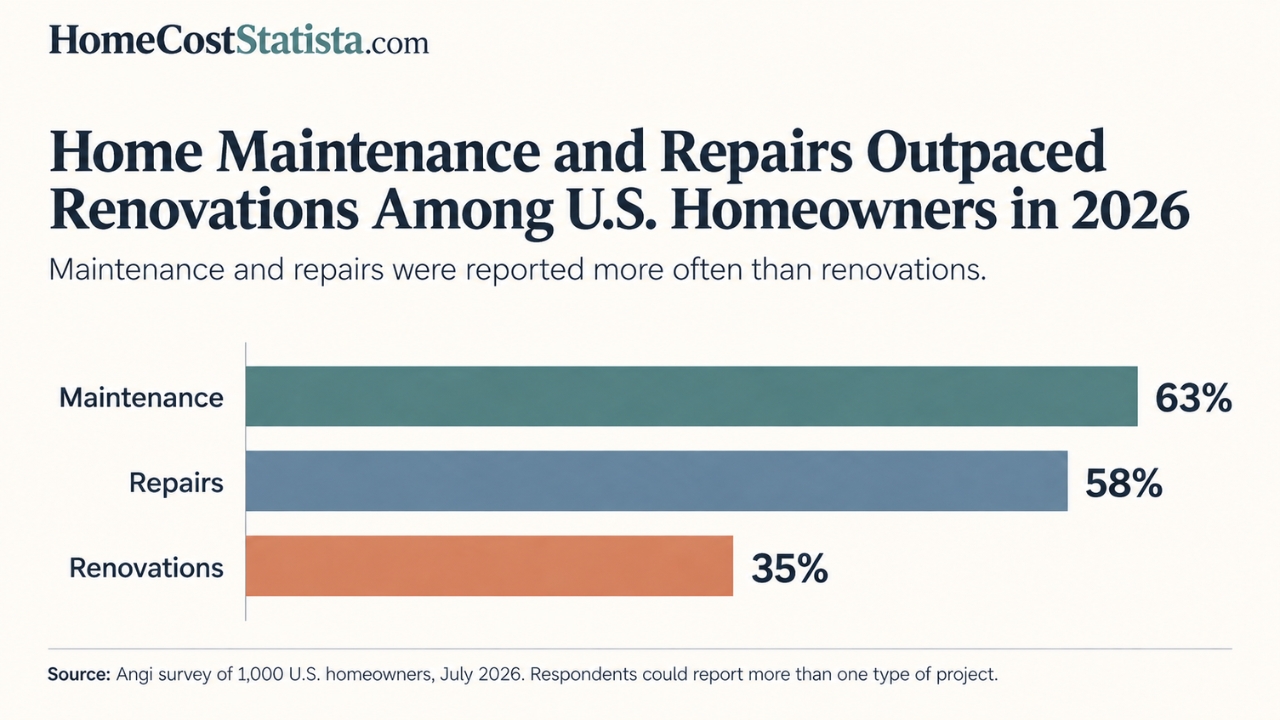
The percentages describe activities during the previous month, and homeowners could report more than one type of work. They should not be interpreted as annual participation rates for every American homeowner.
Still, the difference between repairs and renovations is substantial.
I would be careful about calling this a collapse in homeowners’ interest in renovations. The survey doesn’t establish that. It tells us that among recently active homeowners, essential work is receiving considerably more attention than discretionary improvements.
Frankly, that makes sense to me. A kitchen with outdated cabinets can remain perfectly functional for another few years. A leaking pipe has a rather different understanding of patience.
A House Doesn’t Care About Your Renovation Plans

One thing I learned during my appraisal years is that homeowners tend to think about improvements and repairs very differently.
Improvements feel like investments. New bathrooms, updated kitchens, attractive flooring, and finished basements promise some combination of enjoyment and higher property value.
Repairs are less satisfying. You spend money to return something to the condition you expected it to be in already.
A squeaky floor is one example of a repair that may cost far less than a remodel. You may be able to fix squeaky floors without floor removal.
Nobody gets particularly excited about replacing damaged plumbing. Yet that plumbing might deserve financial priority over an entire list of attractive improvements.
The latest Angi findings suggest this competition is happening in households across the country. Among homeowners who delayed a planned project, 23% cited an unexpected or emergency project as the reason.
I’ve previously examined how unexpected repairs are delaying planned improvements, and the underlying financial problem is worth emphasizing.
A household might have $12,000 saved for a bathroom renovation. If an essential heating system suddenly requires $5,000 in work, the bathroom budget doesn’t remain $12,000 simply because that was the original plan. The money has another job now.
Rising Costs Make the Choice More Difficult
The preference for necessary work becomes easier to understand when we look at what projects are costing.
Research from the Home Improvement Research Institute found that average spending per project reached $5,368 in the first quarter of 2026, compared with $3,957 during the same quarter of 2025.
At the same time, fewer homeowners were completing projects.
I find that combination particularly revealing. A reduction in the number of projects doesn’t necessarily mean homeowners are enjoying much financial relief. The projects that proceed can still demand substantial amounts of money.
Angi also found that 43% of recent professional hires finished above their original project estimates.
Our earlier examination of homeowners exceeding professional estimates explored why hiring an experienced contractor doesn’t eliminate financial uncertainty.
For renovations, that uncertainty becomes another reason to hesitate.
Someone considering a $30,000 kitchen remodel isn’t necessarily deciding whether they can afford exactly $30,000. They need to consider what happens if the final cost becomes $35,000 or $38,000.
I have always preferred homeowners to be cautious with money they haven’t yet committed. Postponing an optional project can be sensible financial management, particularly when the house has other expensive needs.
Older Homes Make Repairs Harder to Avoid
Another factor deserves attention. America’s housing stock is aging.
According to Harvard’s Joint Center for Housing Studies, the median age of the U.S. housing stock reached 44 years in 2023, up from 28 years in 1993. That’s a meaningful change.
🇺🇸 The median age of a U.S. home is a record 44 years, leading to vast and rapidly increasing maintenance and modernization costs.
Financial advisers now suggest setting aside 2% to 3% of a home’s value annually for upkeep, up from the traditional 1%.
https://t.co/00jZ2XVNTa
— Jack Hoogland (@jack_hoogland) April 5, 2026
Older houses aren’t automatically troublesome. During my career, I encountered older properties in excellent condition and much newer ones that already needed serious attention.
Age does, however, increase the likelihood that major components have reached or passed their expected service lives.
Roofs, heating systems, electrical equipment, water heaters, and plumbing don’t operate indefinitely.
What concerns me is the financial gap between knowing a system will eventually need replacement and actually having money available when that happens.
That concern becomes more serious when you consider our recent findings on homeowners with no maintenance budget. Hippo’s research found that 18% of surveyed homeowners had no maintenance budget in 2025, compared with 9% the previous year.
An aging home doesn’t become less expensive to maintain because its owner stops saving.
Renovations Haven’t Lost Their Appeal
I don’t believe the smaller renovation share means homeowners have suddenly stopped caring about improving their properties.
In fact, Angi found that 66% planned to make a major investment in their homes within the next five years. That’s a substantial majority. What seems to have changed is the timing.
A homeowner can want a larger kitchen, better bathroom, or finished basement and still decide that 2026 isn’t the right year to pay for it.
There is also an important distinction between improving a home’s market value and improving its usefulness to the people living there.
Some renovations accomplish both. Others mainly provide personal enjoyment.
I’ve never believed that every renovation needs to produce a financial return. People live in their houses, after all. Comfort has value even when an appraiser cannot assign every dollar back to the property.
But I would strongly discourage homeowners from treating every desirable improvement as financially urgent.
That is how perfectly reasonable renovation plans become unnecessarily expensive obligations.
I Would Keep Repair Money Separate From Renovation Money

The biggest practical lesson I take from these figures is that homeowners need to distinguish between three different kinds of spending.
- Routine maintenance: Predictable expenses such as inspections, servicing equipment, cleaning gutters, and preventing deterioration.
- Repairs and replacements: Money reserved for failures, damage, and major components reaching the end of their useful lives.
- Renovations: Planned improvements to appearance, functionality, comfort, or property value.
All three deserve consideration, but they shouldn’t have equal claims on emergency savings.
HOA properties require another distinction. Although HOA fees have become more common, association dues do not necessarily cover repairs inside an individual home.
Suppose a household saves $400 monthly for home-related expenses. That’s $4,800 annually.
I would rather see that money allocated deliberately according to the property’s condition and upcoming needs than placed into one general home improvement fund.
A new kitchen countertop shouldn’t quietly consume the money intended for an aging furnace.
And renovation budgets need their own contingency. As I explained in my examination of renovations exceeding budgets by 30%, even a relatively ordinary percentage overrun can become a substantial household expense.
The correct allocation will differ from house to house. Its age, condition, systems, and available savings matter far more than following a universal percentage rule.
The Real Story Is About Homeownership Priorities
The 58% repair figure and 35% renovation figure tell me something about how homeowners are responding to expensive housing conditions.
People still want to improve their properties. They’re simply having to be more selective about what receives money first. I actually see some financial discipline in that decision.
What concerns me is whether essential work is consuming so much of household budgets that longer-term improvements and adequate savings become increasingly difficult.
A house needs continuing investment, whether that investment produces beautiful new finishes or merely keeps rainwater outside where it belongs.
After decades of examining residential properties, I’ve come to believe homeowners give far too much attention to what a house costs to purchase and far too little to what it costs to keep.
The latest spending figures are another reminder of that imbalance.
Renovations are generally something homeowners choose to undertake. Repairs are frequently something their houses choose for them. And the house rarely asks whether the timing is convenient.