
Nearly one in five U.S. homeowners now sets aside no money at all for home maintenance.
That is the number that caught my attention in Hippo’s 2026 Housepower Report. The survey found that 18% of homeowners had no maintenance budget in 2025, up from 9% a year earlier. In the space of one year, the share effectively doubled.
I find that more concerning than a homeowner simply having a smaller-than-ideal maintenance budget.
A small budget at least acknowledges something I learned very early in residential property work: houses consume money long, long after you buy them.
A zero-dollar budget assumes either that nothing will go wrong or that the money will somehow appear when it does.
Houses are not particularly interested in either assumption.
Maintenance Budgets Are Getting Smaller
The zero-budget figure is part of a broader shift. According to Hippo, 58% of homeowners budgeted between $500 and $4,500 annually for routine maintenance in 2025, up from 39% in 2024.
At the other end of the scale, the share budgeting $6,501 or more dropped sharply from 35% to 14%.
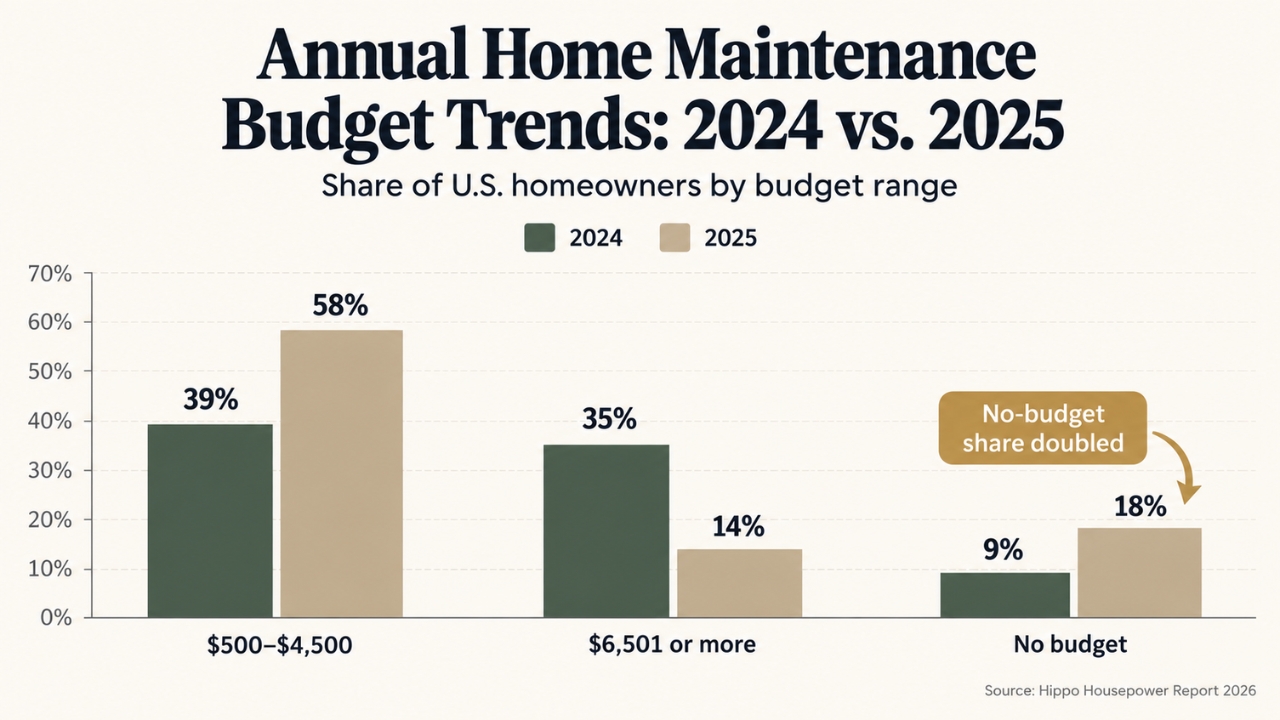
I would be careful about interpreting the middle category as good news. More homeowners landing in the 500 – 4,500 range does not necessarily mean they suddenly discovered sensible budgeting.
The collapse in the highest bracket suggests at least some households are simply spending less or setting less aside.
Hippo itself points to broader financial pressure as one possible explanation.
That seems plausible to me. Housing expenses have become crowded. Mortgage payments, insurance premiums, property taxes, utilities, and HOA fees all compete for the same household income.
In California, some homeowners face an additional expense through approved fees for wildfire claims, despite no damage to their own properties.
HOA fees deserve particular attention. In 2025, 43.6% of U.S. homes for sale had HOA fees, with a median monthly charge of $135.
Winter utility costs add to that pressure, with home heat costs expected to reach $1,030 on average for 2026–27.
Maintenance is unusually easy to cut because nobody sends you a monthly bill demanding that you save for a future water heater. You notice the mistake later.
The Timing Is Particularly Bad
There is another reason the 18% figure bothers me. American homes are getting older.
An NAHB analysis using Census Bureau data found that the median age of an owner-occupied home reached 42 years in 2024, compared with 31 years in 2005. About 47% of owner-occupied homes were built before 1980.
View this post on Instagram
Older does not automatically mean worse. I have seen beautifully maintained 70-year-old houses and comparatively young homes that already had an impressive list of problems.
Age does mean more components have had time to reach the end of their useful lives.
Roofs, HVAC equipment, water heaters, electrical components, plumbing, windows, and exterior materials do not age on the same schedule. That is exactly what makes maintaining a house financially awkward. You can go several quiet years and then have two expensive systems demand attention within six months.
Harvard’s housing research also found that older properties require a larger share of spending on maintenance and replacement. For homes built before 1960, maintenance accounted for 22% of improvement and repair expenditures in 2023, compared with 16% for homes built in 2010 or later.
To me, shrinking maintenance reserves and aging housing stock are moving in precisely the wrong directions.
Unexpected Repairs Are Already Hurting Household Finances
The same Hippo survey provides a fairly good explanation for why having no maintenance budget can become expensive.
One-third of homeowners, 33%, said unexpected repairs or maintenance issues affected their financial stability in 2025. Overall, 76% said at least one home-related issue hurt their financial stability.
Put those figures beside the 18% with no maintenance budget, and the problem becomes clearer.
Homeowners are not eliminating repair costs by eliminating the budget line. They are simply moving those expenses into some other part of their finances.
Angi’s research reveals a similar priority: home repairs outpaced renovations, with 58% of surveyed homeowners reporting repairs compared with 35% who renovated.
That can mean a credit card, emergency savings, financing, delaying another planned home project, or postponing the repair itself.
Homeowners with low-rate first mortgages may consider a second loan to cover urgent repairs. But that decision adds another debt obligation to an already strained household budget.
I have never liked the phrase “unexpected repair” as much as everyone else seems to. A specific failure can certainly be unexpected. You cannot predict that a pipe will leak on February 11.
The fact that something in a house will eventually need repairing is entirely predictable.
Deferred Maintenance Can Become Its Own Bill
A separate Hippo survey, published in May 2026, found that 69% of homeowners had unfinished maintenance or repair tasks. Among those with deferred work, 45% estimated it would cost at least $5,000 to catch up, and 15% put the figure at $20,000 or more.
That is how relatively ordinary home maintenance can turn into a much bigger financial problem.
Some jobs can wait. Faded paint in a spare bedroom is hardly an emergency. A landscaping project can usually be pushed back without threatening the house.
Water intrusion, plumbing problems, roof defects, electrical issues, and deteriorating exterior components deserve a different attitude.
A floor squeak may be minor, but a soft or saggy floor deserves more attention. Our guide to squeaky floor repairs explains how to assess the problem.
One thing I saw repeatedly during my appraisal years was that homeowners became accustomed to defects they saw every day. A stain on the ceiling becomes part of the ceiling. Cracked siding becomes something to deal with next summer. The slow drip under a sink gets a bowl underneath it.
A slow leak can also leave the homeowner responsible for mold repairs, since home insurance coverage for mold often depends on the cause of the water damage.
Then one day the repair estimate arrives, and everyone acts surprised.
Even a professional estimate should not be treated as a guaranteed ceiling once work begins.
Maintenance does not always prevent a major failure, but delaying small problems certainly has a talent for making some of them more expensive.
I Would Not Rely Too Heavily on the 1% Rule
Homeowners looking for guidance frequently encounter the suggestion that they should budget around 1% of a home’s value each year for maintenance and repairs.
I have never put much stock in using a single percentage as though it works equally well for every house.
Consider two $500,000 homes.
One could be a relatively new 1,800-square-foot home in excellent condition. The other could be a much older 3,000-square-foot property with an aging roof, two HVAC systems, mature trees, and decades-old plumbing.
Their market values might be identical. Their maintenance needs certainly are not.
Home value is influenced heavily by location. A modest house in an expensive market can be worth far more than a larger property elsewhere without having proportionally higher maintenance costs.
I would rather see homeowners build a budget around the actual house they own.
Start with its age, size, and condition. Then look at the expensive components individually.
Pay Particular Attention To
- Roof age and condition
- Heating and cooling equipment
- Water heater
- Plumbing
- Electrical system
- Foundation and drainage
- Windows and exterior materials
- Major appliances
- Trees, driveways, decks and other property features
If several expensive components are already well into their service lives, a minimal maintenance budget deserves another look.
Routine Maintenance and Repair Savings Are Different Things
I also think homeowners should separate two ideas that are frequently lumped together.
Routine maintenance covers reasonably predictable expenses such as servicing HVAC equipment, cleaning gutters, inspecting systems, replacing filters, and taking care of smaller repairs.
Repair reserves are money kept available for the larger, less predictable bill.
I would also keep that money separate from renovation budgets, because a project that runs over can quickly consume cash meant for an emergency repair.
You need both.
Hippo found that only 32% of homeowners had created an emergency fund specifically for home repairs. The report recommended doing so because unexpected repairs had already affected the financial stability of roughly one in three homeowners surveyed.
40% of Americans spend most of their paycheck within 48 hours, a habit financial experts warn can hurt homeowners. Here’s how to build a home emergency fund from each paycheck: https://t.co/FRiuL4Pl6O https://t.co/1E9GLzdJmV
— Realtor.com (@realtordotcom) October 5, 2026
I would much rather see someone save a modest amount consistently than become intimidated by a supposedly perfect annual maintenance number and save nothing.
A homeowner who cannot immediately build a large reserve can still begin creating one. The important change is acknowledging that replacing a furnace or repairing a roof is not the same kind of surprise as finding a $20 bill in an old coat.
You know the expense is coming. You simply do not know the date.
The 18% Figure Says Something Bigger About Homeownership

The Housepower survey was conducted for Hippo by Centiment and included 1,619 U.S. homeowners. The data was Census-balanced, with an overall margin of error of approximately plus or minus two percentage points.
So I would not pretend that exactly 18 out of every 100 American homeowners have no maintenance budget. Surveys have limitations, and I am always wary when a precise percentage gets repeated without its methodology.
The direction of the change is harder to dismiss.
Going from 9% to 18% in a year, alongside shrinking higher-end maintenance budgets and widespread reports of financial strain from unexpected repairs, suggests that many homeowners are having a harder time reserving money for the house itself.
And that is the larger issue. Buying the house receives enormous financial attention. People calculate the down payment, mortgage rate, and monthly payment down to the dollar.
The next 10 or 20 years of keeping that house standing rarely receive the same attention.
After decades of looking at residential properties, I think that is one of the strangest habits in homeownership. We treat maintenance like an optional expense even though the physical building is slowly aging every single day.
A maintenance budget will not stop a roof from wearing out or an appliance from failing. It does something almost as useful.
It makes those entirely normal costs of owning a home a little less capable of becoming a financial emergency.