
Nearly 4 million American homeowners have taken out a second loan against their property rather than give up their low-rate mortgage.
I understand the attraction. Anyone who secured a mortgage below 3% has a powerful reason to keep it when new loans cost considerably more.
But I also see a risk: protecting a cheap mortgage while quietly accumulating expensive debt.
3.9 Million Homeowners Have Added a Second Loan

According to Intercontinental Exchange’s June 2026 Mortgage Monitor, approximately 3.9 million homeowners who obtained their primary mortgages between 2020 and 2022 now also carry a second lien.
The first quarter of 2026 revealed just how popular this borrowing strategy has become.
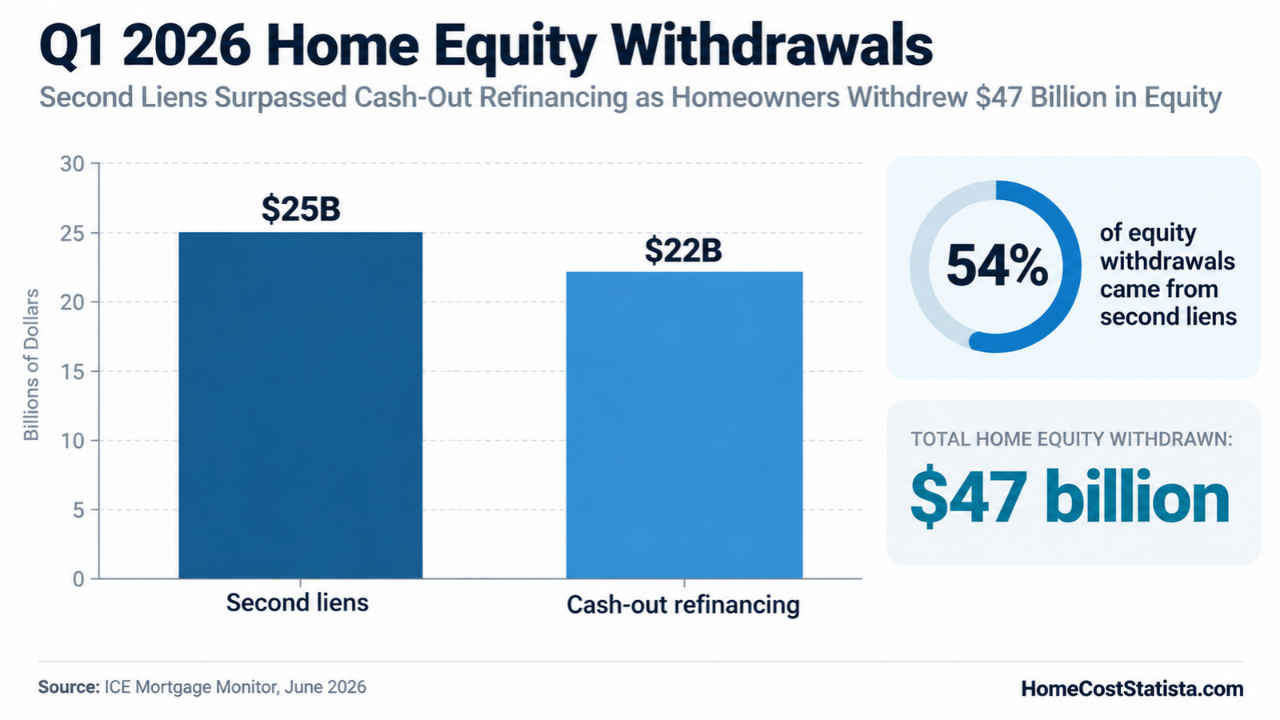
Second-lien withdrawals reached their highest first-quarter level in 18 years. Nearly two-thirds of new second-lien loans went to homeowners who obtained their original mortgages between 2020 and 2022.
Those numbers tell me something important. Homeowners haven’t necessarily lost their appetite for borrowing. They’ve found a way to borrow without disturbing the best mortgage rates they’ve ever had.
Why Give Up a 3% Mortgage When New Rates Are Above 7%?
During 2020 and 2021, millions of Americans obtained mortgages at exceptionally low rates.
Some locked in 30-year fixed rates below 3%.
Compare that with October 15, 2026, when the average 30-year fixed mortgage rate reached 7.40%, according to Freddie Mac’s mortgage rate data.
View this post on Instagram
The difference is enormous.
Consider someone with a $200,000 remaining mortgage balance at 3%. Refinancing that balance at 7.40%, even before borrowing additional money, would substantially increase the interest cost.
Instead, homeowners are using second mortgages to access their equity while leaving the original loan untouched.
Two Ways to Access Home Equity
| Home equity loan | HELOC |
| Provides a lump sum | Offers a revolving credit line |
| Generally has a fixed interest rate | Usually has a variable rate |
| Scheduled principal and interest payments | Payments can change, especially after the draw period |
| Often suited to one large expense | Often suited to expenses spread over time |
Both are secured by the property, and neither requires replacing the original mortgage.
I would be reluctant to surrender a 2.75% mortgage myself. But that doesn’t mean I would automatically consider a second loan a good idea.
The purpose of the borrowing matters just as much as the rate.
A $50,000 Second Loan Might Cost Just $275 a Month — Initially

ICE reported that average second-lien HELOC rates had fallen to 6.6% in March 2026, their most attractive level since late 2022.
At that rate, borrowing $50,000 would mean an interest-only payment of approximately $275 per month.
That sounds manageable, especially for a household with substantial equity.
But here’s the calculation I would want every borrower to understand.
An Illustrative $50,000 HELOC at 6.6%
- Interest-only monthly payment: $275
- Principal repaid during an interest-only period: $0
- Balance remaining after five years of interest-only payments: $50,000
- Interest paid over those five years: $16,500, assuming the rate and balance remain unchanged
After five years, the homeowner could have spent $16,500 without reducing the debt by a single dollar.
And if the rate rises, the interest payment can rise with it.
The Consumer Financial Protection Bureau also warns that HELOC payments can increase sharply when principal repayment begins.
I’ve always been wary of financial arrangements that look affordable only because the larger bill comes later.
Home Equity Is Not the Same as Cash in the Bank
One thing I learned during my years as a residential appraiser is that homeowners can become overly comfortable with the equity they believe they’ve accumulated.
Let’s consider a simple example.
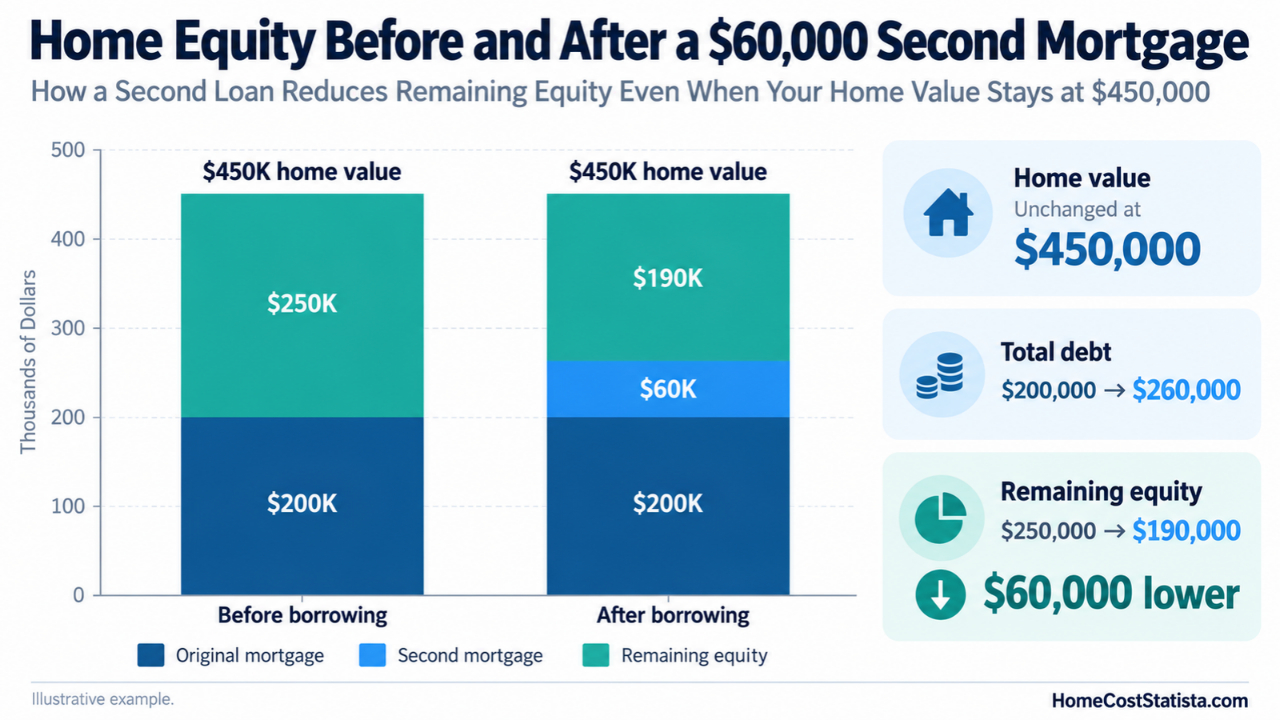
The homeowner still owns a $450,000 property, but now owes $260,000 against it.
Nothing about the house itself has improved simply because the owner withdrew $60,000.
If that money pays for essential structural repairs, I can see the logic. If it finances a discretionary renovation, I would be more cautious.
As I discussed in my earlier article on renovations that exceed their original budgets, spending on home improvements can become considerably more expensive than planned.
And there’s no guarantee a $60,000 improvement will increase a property’s market value by $60,000.
I’ve valued enough homes to know that renovation costs and market value don’t always move together.
Are Homeowners Borrowing Because They Want To, or Because They Have To?
This question concerns me more than the growth in second mortgages itself.
Some homeowners are borrowing to improve their properties. Others may need money for unavoidable expenses.
Consider the pressures we’ve been seeing:
- Home insurance costs have risen nearly 50% in five years.
- The share of homeowners with no maintenance budget doubled to 18%.
- Unexpected repairs are forcing homeowners to delay planned projects.
A cheap mortgage doesn’t protect anyone against an aging roof, rising insurance premiums, or a failing heating system.
Nor does a low mortgage rate eliminate HOA dues. In 2025, 43.6% of U.S. homes for sale had HOA fees, with a median charge of $135 per month.
During my appraisal career, I visited properties where owners had postponed maintenance for years. Sometimes they simply didn’t have the money.
I worry that some homeowners are now using their equity as a financial cushion rather than building savings.
To be clear, the ICE figures don’t tell us how many borrowers are struggling financially.
Still, I believe there’s an important distinction between borrowing to make a property more useful and borrowing because ordinary homeownership expenses have become difficult to manage.
The Mortgage Lock-In Effect May Be Keeping Homes Off the Market
Second mortgages also have implications for the wider housing market.
Someone with a 3% mortgage might normally consider moving to a larger property or downsizing after retirement.
But moving today could mean exchanging that inexpensive loan for one above 7%. That’s a difficult trade.
So rather than move, homeowners may renovate, expand, or borrow against their existing properties.
I suspect this is contributing to the reluctance of some owners to sell.
Fewer existing homes coming onto the market can make life harder for prospective buyers, particularly those purchasing their first property.
Of course, second mortgages aren’t the sole reason housing inventory remains constrained. But they are another sign of how much the mortgage lock-in effect influences homeowner decisions.
When Would I Consider a Second Mortgage Sensible?
I wouldn’t discourage every homeowner from taking one out.
If someone has substantial equity, dependable income, and a necessary expense, preserving a low-rate first mortgage while using a second loan can make financial sense.
But I would ask four questions before signing anything:
- Is the expense necessary? Repairing a leaking roof is different from installing a luxury kitchen.
- Can I afford the eventual payment? The initial interest-only payment may not reflect the long-term obligation.
- What if my income or home value falls? Equity can shrink, but mortgage debt remains.
- Have I compared the alternatives? Savings, delayed spending, and other financing options deserve consideration.
Both mortgages put the property at risk if the borrower cannot meet the payments.
That’s why I would look beyond the interest rate and examine the household’s entire financial position.
My Two Cents…
@mortgageswithpower 2nd mortgages, really are a good product, but BEWARE! #mortgages #canada #debt #money #homeowner ♬ som original – 𝙇𝙚𝙤🎙𝙁𝙡𝙖𝙨𝙝𝙗𝙖𝙘𝙠🎶🎵
I understand why millions of homeowners want to protect their exceptionally low mortgage rates. In many cases, taking a second loan is preferable to refinancing.
But keeping a cheap mortgage doesn’t necessarily mean keeping housing costs affordable.
After decades of valuing homes, I still believe the strongest financial position isn’t having the most equity available to borrow.
It’s having the least need to borrow against it.