
Homeowners have spent the past few years worrying about mortgage rates and home prices. I think another housing cost deserves a great deal more attention: insurance.
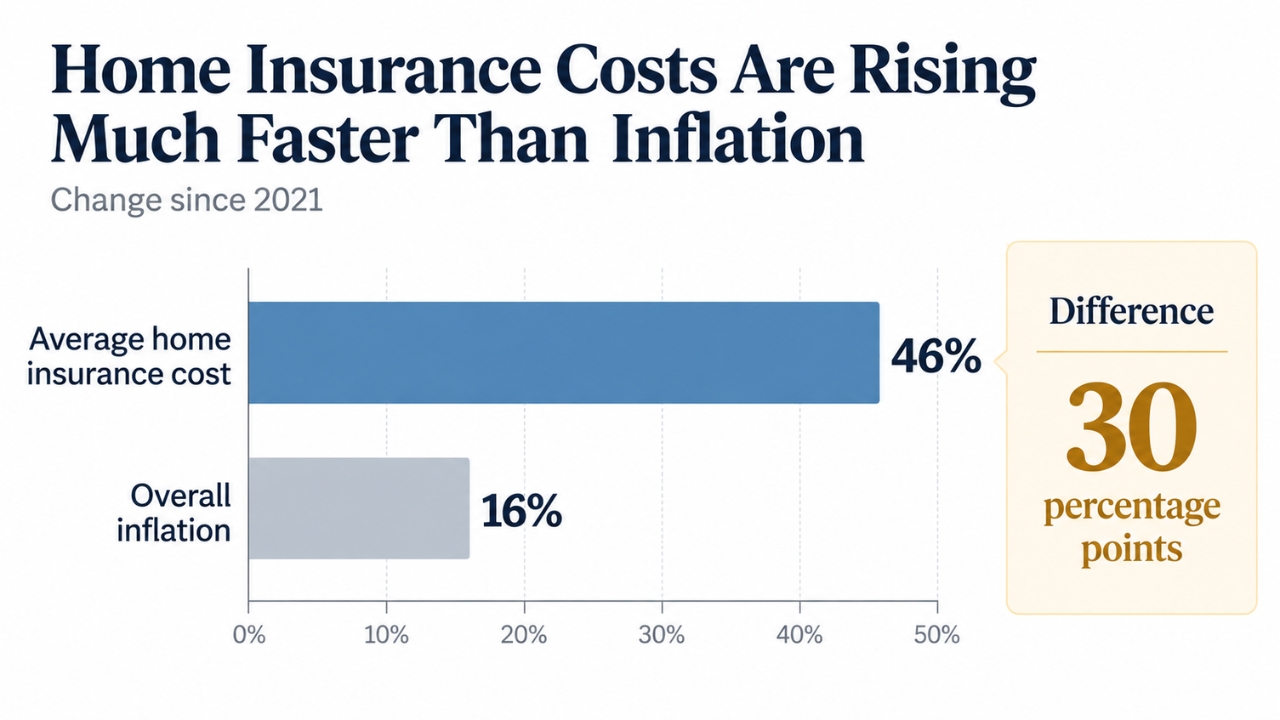
The average cost of home insurance has risen 46% since 2021, according to Insurify’s 2026 analysis. General inflation increased about 16% over the same period. In other words, home insurance prices have risen at close to three times the overall inflation rate.
That is an extraordinary increase for an expense many homeowners once treated as a fairly predictable line in the household budget.
During my appraisal years, insurance was rarely one of the first numbers buyers wanted to discuss. They were focused on purchase price, mortgage payments, and property taxes. Insurance was something you obtained before closing and then allowed the mortgage company to handle through escrow.
I would not treat it that casually today.
According to the same analysis, the national average annual premium reached $2,948 in 2025, up 12% in one year. Its analysts projected another increase to $3,057 by the end of 2026.
A homeowner paying roughly $2,000 several years ago could therefore be looking at another $900 or $1,000 of annual housing expense today without changing houses, taking out a larger mortgage or renovating a single room.
That is roughly another $75 to $85 per month.
For plenty of households, that really, really matters.
Home Insurance Has Outpaced General Inflation
The 46% increase deserves context.
I am always careful with national averages. A homeowner in Vermont has very little in common, from an insurance-risk perspective, with someone living near the Florida coast or in a hail-prone part of Oklahoma.
Still, the national trend tells us something important. Insurance has become one of the fastest-moving components of homeownership costs.
Official data show the increase began well before 2025. The National Association of Insurance Commissioners reported that the nationwide average premium for owner-occupied homeowners policies increased 6.97% from 2020 to 2021. The following year brought another 10.5% increase.
I have watched plenty of housing expenses move up and down over the years. Insurance concerns me because homeowners have relatively little control over many of the forces pushing the price higher.
Why Home Insurance Has Become So Expensive

There is no single explanation for a 46% increase.
Several costs have been moving in the same direction at once.
Disasters Are Producing Expensive Losses
Weather risk receives much of the attention, and with good reason.
The U.S. Treasury Department analyzed more than 246 million homeowners policies covering 2018 through 2022. Homeowners living in the 20% of ZIP codes with the highest expected losses from climate-related perils paid an average premium of $2,321.
The survey found homeowners living in areas most at risk of severe weather events paid an average annual premium of $2,321, 82 per cent higher than those who lived in areas least likely to be hit. https://t.co/og5VcMRrSU
— The Weather Network (@weathernetwork) January 18, 2025
That was 82% higher than premiums in the lowest-risk 20% of ZIP codes, according to the Treasury Department analysis.
Claims were more expensive in high-risk locations as well. Treasury found an average claim severity of roughly $24,000 in the highest-risk areas, compared with about $19,000 in the lowest-risk areas.
Insurance pricing has always been about risk. What has changed is the size of some losses and the concentration of valuable homes in places exposed to wildfire, hurricanes, hail, wind and other hazards.
The issue extends far beyond Florida hurricanes and California wildfires. Severe thunderstorms, hail and tornadoes have placed growing pressure on insurers across the Midwest and Great Plains.
California offers a clear example. Some homeowners now face extra charges to help fund wildfire claims, even if their own properties suffered no damage.
After decades around residential property, I think homeowners frequently underestimate hail because it lacks the drama of a major hurricane. From an insurer’s point of view, thousands of damaged roofs spread across several states can become enormously expensive.
Rebuilding a House Costs More
Insurance companies are concerned with what a house will cost to repair or rebuild after a loss.
That figure is different from market value.
Your home might sell for $450,000 while carrying a completely different replacement cost because the land, neighborhood, local housing demand, and construction expenses all affect the two figures differently.
The distinction matters more after several years of expensive construction labor and materials.
The Bureau of Labor Statistics documented sharp increases in construction inputs beginning earlier in the decade, including large jumps in lumber, steel, millwork, roofing products and other construction materials.
More recent insurance-industry estimates have also pointed to continued increases in building-material costs.
If replacing a roof that once cost $15,000 now costs $22,000, the insurer faces a larger potential claim. Multiply that change across thousands of homes after a major storm and the economics become fairly obvious.
One thing I saw repeatedly during my appraisal years was homeowners confusing what their property was worth with what the structure would cost to reproduce. Insurance has made that distinction much harder to ignore.
Where You Live Matters More Than the National Average
I would be careful telling any homeowner that insurance “costs about $3,000 a year.”
Location can make that figure nearly meaningless.
Insurify reported the following average annual premiums at the end of 2025:
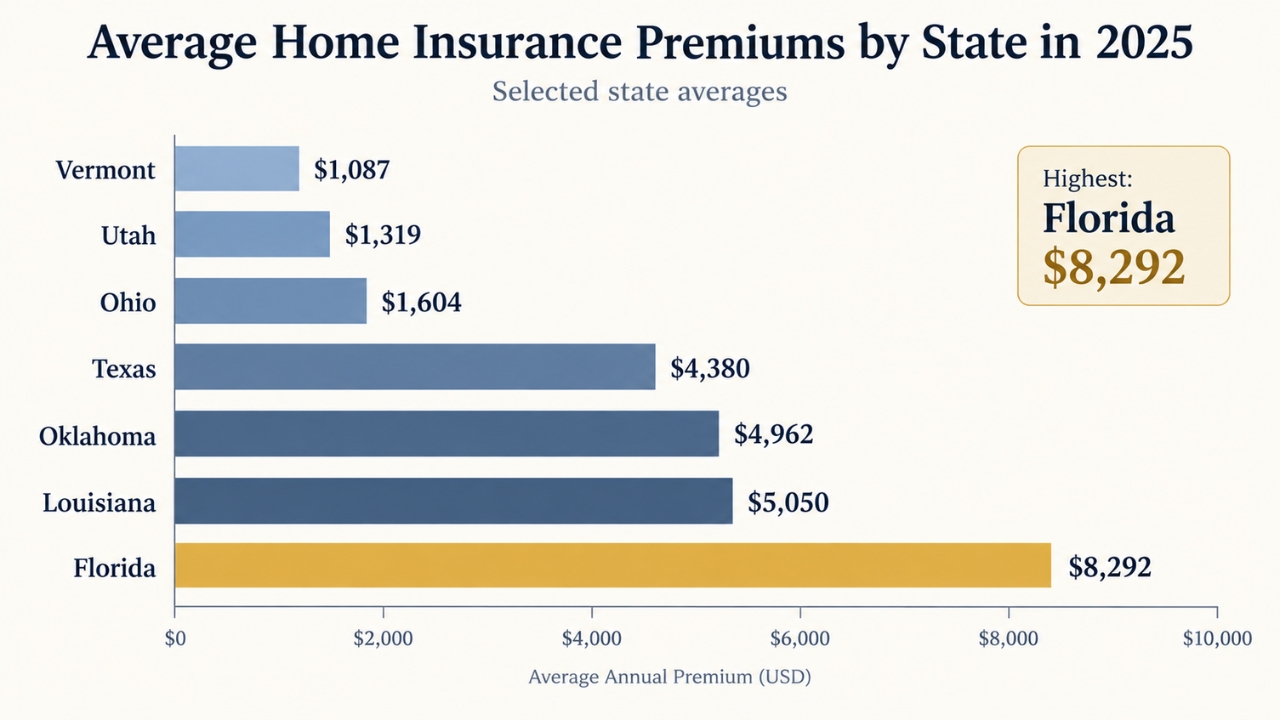
A Florida homeowner paying more than $8,000 per year is living in a very different affordability environment from a Vermont homeowner paying a little over $1,000.
Premium changes can also move quickly within a state. Minnesota’s average premium rose 34% during 2025, while Nebraska increased 25% and Oklahoma 24%.
State averages still conceal differences among counties, neighborhoods, and individual properties.
Two houses worth roughly the same amount can carry very different premiums because of roof age, construction type, wildfire exposure, distance from fire protection, previous claims, deductible choices, and other underwriting factors.
Rising Insurance Costs Are Starting to Change Household Decisions
Here is where the story becomes more important than another inflation statistic.
The Federal Reserve’s 2026 report on household economic well-being found that 6% of homeowners had no homeowners insurance.
View this post on Instagram
Among insured homeowners, 20% said they wanted more coverage but could not afford it, while 14% said they struggled to afford their premiums.
More than six in ten said insurance costs had increased more than they expected in recent years, according to the Federal Reserve report.
I find those figures far more revealing than another national premium average.
Insurance is supposed to transfer a large financial risk away from the household. When homeowners respond to higher premiums by cutting coverage, accepting much larger deductibles or going uninsured, more of that risk ends up back on the homeowner’s balance sheet.
Someone can save $800 a year by choosing a much larger deductible and then discover after a storm that they need to produce $10,000 before insurance provides meaningful help.
Saving money on insurance is sensible. Taking on a financial risk you cannot absorb is a very different decision.
Read the Policy Before Celebrating a Lower Premium

Shopping around is one of the first things I would do after a large renewal increase. The NAIC also recommends comparing insurers when premiums rise.
Price alone tells only part of the story.
Pay attention to:
- dwelling coverage limits;
- deductibles;
- separate wind or hurricane deductibles;
- roof coverage;
- replacement-cost versus actual-cash-value coverage;
- exclusions;
- additional living expense coverage;
- available mitigation discounts.
Roof coverage deserves particular attention. Some policies pay replacement cost, while others use actual cash value and account for depreciation.
The NAIC explains the difference between actual cash value and replacement cost, and that distinction can leave the homeowner with considerably more of the replacement bill.
A cheaper premium loses some of its appeal if the policy has quietly shifted thousands of dollars of risk back to you.
Mold is one example. Homeowners should check their home insurance mold coverage before assuming that water damage automatically qualifies for a claim.
Insurance Should Be Part of the Home-Buying Budget
@brandpropertiesgroup 🏡 Homeowners insurance is an important part of your homebuying budget, and it is one expense buyers don’t want to overlook. Premiums are still rising, but recent data shows the pace of those increases is beginning to slow. Because insurance costs can vary based on the home, its location, coverage, and upgrades, getting quotes early can help you understand the full cost of owning a home before you commit. In this video, Suzie shares a few ways buyers can prepare, including comparing insurance companies, asking about discounts, bundling home and auto policies, and making sure improvements such as a new roof are considered. Ready to begin your home search? Suzie and Brand Properties Group would love to help! 📞 (972) 539-6555 📧 [email protected] #brandpropertiesgroup #kellerwilliams #kellerwilliamsrealty #gonetwork #homebuyingtips @Stacey Sauer @Suzie Burress ♬ Open – Teesa
I have always thought buyers spend too much time asking, “What house price can I afford?” and too little time asking, “What will owning the house cost me every year?”
Those are different questions.
Mortgage principal and interest are only the beginning. Property taxes, insurance, utilities, maintenance, HOA fees, and unexpected repairs that can delay planned home projects continue long after closing.
Utilities can move sharply too, with home heat costs forecast to average $1,030 this winter, up 8.7%.
Maintenance deserves its own line in that calculation too, especially when the share of homeowners with no home maintenance budget has doubled.
Insurance deserves a realistic estimate before buying a house, particularly in areas exposed to hurricanes, wildfire, hail, or severe storms. I would obtain an actual insurance quote for the property rather than plugging a generic national average into a mortgage calculator.
A difference of $4,000 per year is more than $330 per month. That can materially change whether a house fits a household budget.
A 46% Increase Changes the Economics of Homeownership

Home insurance is still smaller than the mortgage payment for most owners, so it is easy to treat the premium as a secondary expense.
I think that is becoming a mistake.
A 46% increase in five years changes the numbers, particularly when property taxes, maintenance expenses and borrowing costs have also risen.
The gap between home repairs and renovations offers another perspective on household priorities, with repairs reported far more often than renovations.
The Federal Reserve has found that the combined cost of home prices, mortgage rates, property taxes and homeowners insurance pushed the cost of owning a home relative to median income to its highest level since 1980 in 2023. That affordability pressure was discussed in a Federal Reserve housing speech.
Insurance will never be the most exciting number on a home-buying spreadsheet. During most of my career, few people wanted to talk about it for very long.
Today, I would give it a full line of its own.
Check the premium before buying. Review the policy at renewal. Compare quotes. Know the deductible. Understand how the roof is covered. Make sure the dwelling limit reflects realistic rebuilding costs.
And when someone tells you the “average” homeowner pays a certain amount, ask where that homeowner lives.
After nearly four decades of watching housing numbers, I have learned that the average is usually where the useful questions begin.