

Nearly 44% of homes listed for sale in the United States in 2025 came with a homeowners association fee. To me, that is more than a real estate statistic. It is a reminder that the price on a listing is becoming an increasingly incomplete description of what a home will cost.
According to Realtor.com’s 2025 HOA report, 43.6% of listings carried a reported monthly HOA charge. The median fee reached $135. For stretched buyers, both figures matter.
HOA Fees Are Becoming More Common, and More Expensive
The longer-term trend tells a clearer story than the headline alone.
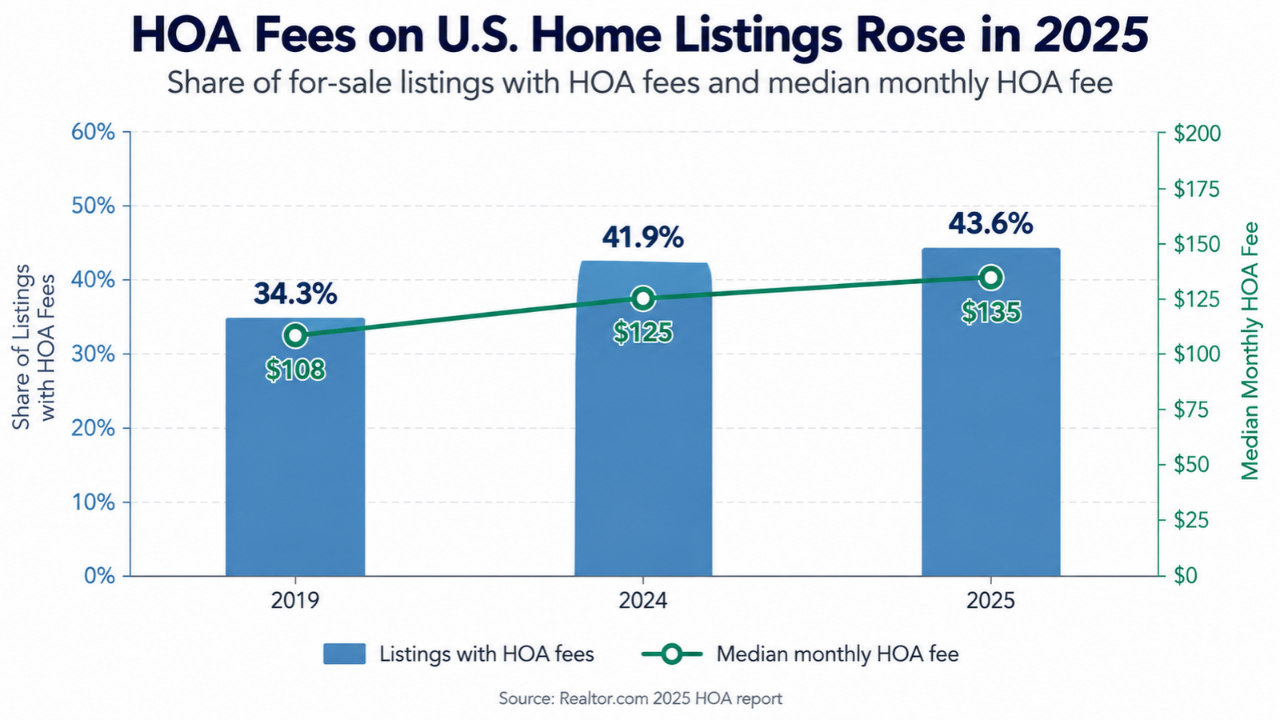
The share of listings with dues rose 9.3 percentage points between 2019 and 2025. Meanwhile, the median fee climbed 25%. Bear in mind that it is a recurring bill, not a one-time expense.
There is an important distinction in these numbers. Realtor.com analyzed weekly snapshots of for-sale listings with a reported fee greater than zero.
This does not mean 43.6% of every home in America belongs to an HOA, nor does the $135 median describe what every HOA homeowner pays.
The distinction is very important: listing data should not be mistaken for a census of all homes.
The New-Construction Boom Is Changing the Resale Market

HOAs used to be associated mainly with condominiums, townhouses, and certain planned developments. That picture is getting outdated.
In 2025, 67.9% of newly built listings had HOA dues, compared with 38.9% of existing-home listings. And while 84.8% of condos and townhomes came with fees, so did 33.4% of single-family houses.
As Scotsman Guide reported, HOA-heavy development in recent years is now feeding into resale inventory. Houses built in association-governed neighborhoods do not stop having dues when their first owners move out.
Avoiding an HOA may therefore be difficult in some growing markets. In my appraisal years, I saw how similar-looking houses could carry very different ownership responsibilities.
A $135 Fee Is Really a $1,620 Annual Commitment
The national median might sound manageable when expressed monthly. Multiply it by twelve, though, and $135 becomes $1,620 a year. At an unchanged rate, that would be $16,200 over ten years, before any special assessments.
Higher dues change the picture quickly: $250 a month is $3,000 annually, $400 is $4,800, and $600 is $7,200. These are illustrations, not national averages, but they show why a seemingly affordable home can be expensive to carry.
HOA dues are usually paid separately from the mortgage, yet lenders generally consider them when calculating housing expenses and loan affordability. Fannie Mae’s monthly housing expense guidance explicitly includes association dues.
Personally, I would rather see buyers qualify comfortably with every recurring expense included than purchase a home that works on paper only because several bills have been mentally set aside.
HOA Dues Aren’t Automatically Wasted Money
I do not think an HOA is inherently a bad thing. Dues can pay for landscaping, private roads, security, snow removal, shared facilities, and, in many condo developments, essential building upkeep.
The fair comparison is not necessarily HOA fee versus zero cost. A homeowner outside an association may have to pay for some of those services individually. Well-managed associations can make shared maintenance more predictable.
But buyers need to know what their money actually covers. A community with a pool, clubhouse, and attractive entrance is not necessarily a community with healthy finances. Dues also do not replace personal repair savings.
That is particularly worth remembering when 18% of homeowners reported no maintenance budget in a recent survey. An association cannot protect an owner from every expense inside the property.
Where You Buy Makes an Enormous Difference
National medians conceal striking geographic differences. Nevada led the country with HOA dues attached to 68.3% of listings in 2025. South Dakota was at the opposite end, at 12.3%.
View this post on Instagram
Florida tells an even more interesting story about cost. In the Miami–Fort Lauderdale–West Palm Beach metro, the median HOA fee was $617 a month.
Realtor.com calculated that as 26.9% of an estimated monthly principal-and-interest mortgage payment, using a standardized 6% rate and 10% down payment. It is not a percentage of an owner’s complete monthly housing bill.
Higher insurance costs and new condominium inspection and reserve requirements following the 2021 Surfside collapse have helped push up expenses in parts of Florida, as ConsumerAffairs noted.
I have written about how home insurance costs have risen sharply. What worries me here is the way one rising expense can feed another: the association’s insurance premium goes up, and owners eventually feel it through their dues.
Beyond HOA dues, some California homeowners also face approved wildfire insurance surcharges on their own policies.
Do Homes With HOAs Actually Offer Better Value?
Realtor.com’s figures show a median listing price of $450,000 for existing homes with HOAs, versus $374,900 for existing homes without them. But I would be very cautious about interpreting that difference as an HOA premium.
These are not identical properties. Existing HOA homes were newer on average, with an average construction year of 1998 versus 1968 for non-HOA homes. Size, location, and condition also matter.
Here’s how broken the housing market is:
US newly built homes were more expensive than existing homes by only 3% on average this year.
This is the lowest premium for a new home since the early 1980s and in-line with the early-1970s.
By comparison, the average premium for a new home since 1968 has been 16%, or ~5 times higher.
This comes as existing homeowners have refrained from selling their homes, reducing supply to near record lows.
At the same time, new homes are getting smaller and less sophisticated.
You know something is wrong when new is getting cheaper than old.
— The Kobeissi Letter (@KobeissiLetter) December 5, 2024
My appraisal background makes me skeptical of easy comparisons. A higher asking price does not prove an association raises value; a monthly fee does not automatically make a property poor value.
Five Things I’d Check Before Buying
If I were evaluating an HOA property today, I would want answers to five questions before becoming emotionally attached to the house:
- What do the dues cover? Clarify maintenance, insurance, utilities, and amenities, and what remains your responsibility.
- How strong are the reserves? Review budgets, financial statements, and any available reserve study. Low dues mean little if major repairs are unfunded.
- Are assessments coming? Ask about pending projects, recent special assessments, and any planned fee increases.
- What restrictions apply? Read the governing documents for rules on renovations, rentals, parking, and property use.
- Can my budget handle an increase? Test the payment against higher dues as well as taxes, insurance, and repairs.
A clean entrance suggests day-to-day upkeep; it cannot tell you whether the association can afford a major roof replacement.
The Cost of Ownership Matters More Than the Listing Price

The 43.6% figure signals a lasting change in the choices available to homebuyers. HOAs are spreading beyond the property types where buyers once expected them, and dues are rising alongside other ownership costs.
My view is rather simple – an HOA fee is neither a reason to reject a house nor a detail to dismiss. It is an ongoing financial obligation that deserves the same scrutiny as taxes and insurance.
The right purchase is the home whose total cost still makes sense after the excitement of moving in has worn off.