
A renovation budget that runs a few hundred dollars high is irritating. A project that finishes 30% above budget is a financial event.
New 2026 research from Angi found that 43% of homeowners who recently hired a professional for home improvement work spent more than their original estimate.
Among those who went over, slightly more than one-third ended up spending at least 30% more than planned.
I’ve looked at residential property costs for long enough to be suspicious whenever an overrun is described as a “surprise.” Some genuinely are. Open a wall in an older house, and you can discover plumbing, wiring, moisture damage, or framing problems nobody could see beforehand.
Plenty of overruns have a more ordinary explanation: the original budget was too optimistic.
And at 30%, optimism gets expensive very quickly.
What a 30% Renovation Overrun Actually Costs
Percentages have a habit of sounding less alarming than dollars.
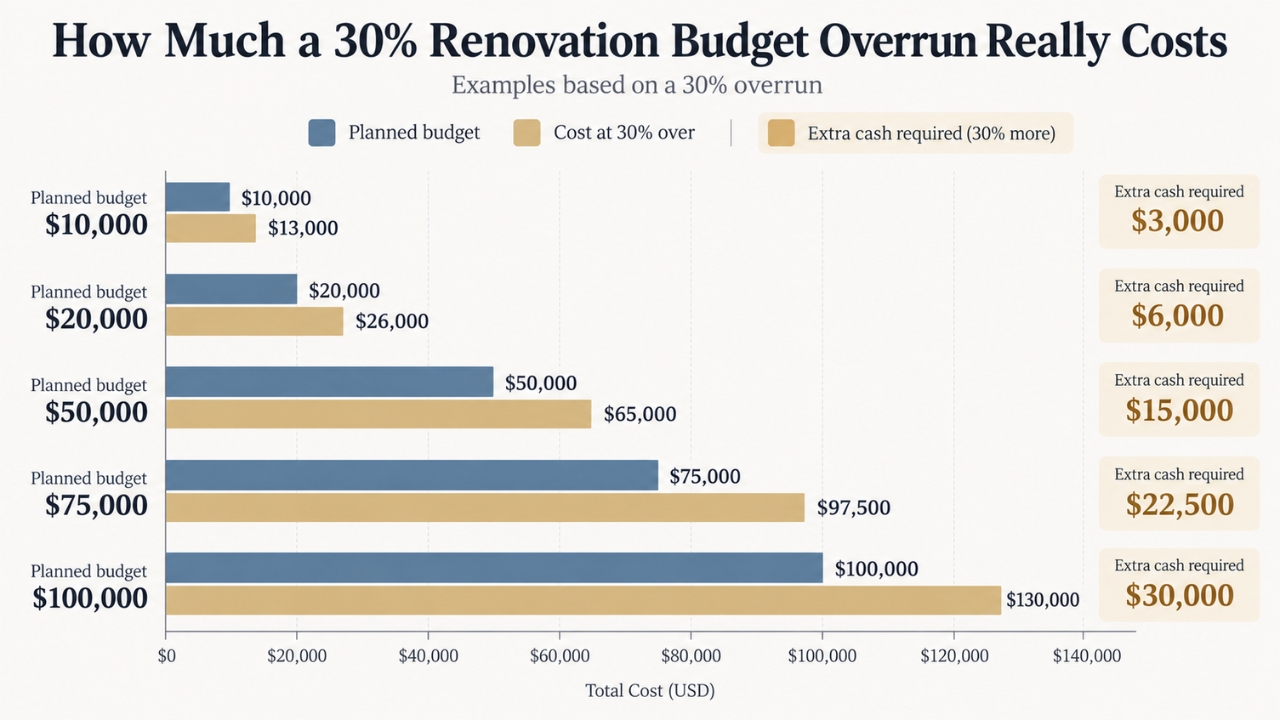
If a homeowner plans a $20,000 project and finishes 30% over budget, the final bill is $26,000. On a $50,000 renovation, the same overrun adds $15,000.
Some homeowners may use a second mortgage to cover renovation cost overruns without giving up their low-rate first loan. The additional debt, however, can outlast the renovation itself.
That is why you should never consider renovation budgeting a minor part of homeownership. A $15,000 overrun can wipe out an emergency fund, push spending onto a credit card, or force you to postpone another major expense.
The larger the project, the less useful it becomes to think of an overrun as “just another 10% or 20%.”
There Is an Important Detail Behind the One-in-Three Figure
View this post on Instagram
I would put one qualification beside the Angi statistic.
The survey was conducted among 1,000 U.S. homeowners who had hired a professional during the previous 12 months for a home improvement, repair, or maintenance project.
It was not limited to people completing traditional remodels such as kitchens, bathrooms, or additions.
That very much matters.
Replacing a failed water heater and renovating a kitchen are both home projects, but their budgets are way more different. I would not use the Angi number to claim that exactly 43% of full-scale renovations exceed budget.
Fortunately, another large dataset points in the same general direction.
Houzz surveyed more than 10,000 U.S. homeowners who renovated in 2025 and found that 37% exceeded their initial budget. Another 35% finished on budget, while only 3% came in below it. A quarter had started without setting a budget at all.
So even after narrowing the discussion specifically to renovation, budget overruns remain remarkably common.
Higher Prices Explain Only Part of the Problem
The obvious explanation is inflation: contractors charge more, materials cost more, and therefore renovations exceed their estimates.
There is truth in that, but I think it is too convenient to stop there.
Among Houzz respondents who went over budget, 52% said products or services cost more than expected. That was the most common reason.
Yet 35% said they selected more expensive products or materials than originally planned, while 31% changed the scope or design during the project.
Those are very different types of overruns.
One comes from the market. The other comes from decisions made after the budget has already been written.
Scope Creep Has a Price
I saw versions of this throughout my appraisal years. A homeowner begins with a fairly defined improvement and then starts making comparisons.
If the cabinets are being replaced, perhaps the countertops should be upgraded. Once the countertops change, the backsplash suddenly looks dated. Then somebody notices the lighting.
None of those decisions is irrational. The problem is that the original $35,000 renovation is still sitting in the homeowner’s mind even after the project itself has become a $45,000 renovation.
74% of homeowners who renovated have regrets.
But here’s what nobody talks about:
— Maket (@Maketplans) February 27, 2026
That is not really a budget overrun. It is a larger project wearing the old project’s budget.
I think homeowners should separate the two when reviewing their costs. Money spent because the contractor discovered a damaged subfloor belongs in a different category from money spent because you decided you preferred the $7,000 countertop option.
Both affect your bank account. Only one was genuinely unexpected.
Hidden Complexity Is Still a Serious Problem
Homeowner choices do not explain everything.
Houzz found that 32% of those exceeding budget said the project was more complex than expected, while 22% encountered unexpected construction-related issues.
Older houses deserve particular caution here.
Not every floor noise points to an expensive defect. Before you budget for replacement, see how to fix squeaky floors without floor removal.
A finished room tells you very little about what is behind the drywall. Once demolition starts, decades of repairs, alterations, leaks, electrical work, and shortcuts can reveal themselves rather quickly.
Mold behind drywall is another costly discovery. Even then, home insurance mold coverage may exclude damage caused by long-term moisture.
One thing I learned from years around residential properties is that houses rarely read the renovation spreadsheet before deciding what needs fixing.
That is why I am much less comfortable with tight contingency budgets on older homes, major plumbing or electrical projects, structural work, and renovations involving extensive demolition.
Homeowners Are Becoming More Cautious

The budget pressure is beginning to influence which projects happen at all.
Home Improvement Research Institute data for the second quarter of 2026 found that only 38% of homeowners had completed a home improvement project during the previous 90 days, the lowest share in five quarters.
At the same time, average spending among households that did undertake projects more than doubled from the previous quarter, according to HIRI’s project activity tracker.
That combination interests me.
Fewer households are doing work, while those still moving forward are committing substantially more money. It suggests the home-improvement market is becoming concentrated among homeowners who either have the financial capacity to proceed or have projects important enough that postponement is difficult.
HIRI also found that 30% of homeowners planned to spend less on home improvement over the following 12 months, compared with 27% planning to spend more.
That sounds less like Americans losing interest in their homes and more like households becoming selective.
Repairs Are Beating the Dream Renovation
Angi’s survey shows the same shift from another angle.
The home repairs versus renovations figures reveal a clear difference: 63% of surveyed homeowners reported maintenance, 58% repairs, and just 35% renovations.. Nearly one-quarter of homeowners who delayed a planned project said unexpected repairs had forced them to delay other home projects.
I find that entirely believable.
Homeownership has always involved competition between the improvement you want and the repair the house decides you need.
A bathroom remodel can usually wait. A failed furnace, leaking roof, electrical problem, or broken sewer line generally does not care about your remodeling schedule.
That is also why spending every available dollar on a discretionary renovation makes me uncomfortable. A house can produce its own invoice while your contractor is still working.
A 10% Cushion Should Not Be Treated as a Universal Rule

Homeowners are frequently told to add roughly 10% to a renovation budget for contingencies. It is a useful starting point for some projects. I would never treat it as a law.
The Angi results make the limitation obvious. More than one-third of homeowners who exceeded their estimates went at least 30% over. A 10% reserve would have absorbed only one-third of an overrun that large.
The appropriate cushion depends on the project.
A cosmetic job in a relatively new home with clearly specified materials presents a different risk from opening walls in an 80-year-old house. Structural alterations, old plumbing, electrical upgrades, and poorly documented previous renovations all create more opportunities for expensive discoveries.
My preference is to budget according to uncertainty rather than simply attaching the same percentage to every project.
The Estimate Needs to Be More Than One Number

I would also pay close attention to how detailed the contractor’s estimate actually is.
A low total at the bottom of a page does not tell you much if major allowances, material selections, permit costs, disposal, labor assumptions, or likely repair work remain unresolved.
Before work begins, I would want a homeowner to know:
- exactly what work is included;
- which materials and fixtures have fixed prices;
- which items are allowances;
- what is specifically excluded;
- how change orders will be priced;
- what happens if hidden damage is discovered.
The cheapest estimate can become the most expensive project when too many decisions have simply been pushed into the future.
I have always preferred a less exciting number that is realistic to a wonderfully low number that survives until demolition day.
Renovation Spending Is Still Enormous
None of this means homeowners have stopped improving their properties.
Harvard’s Joint Center for Housing Studies expects annual spending on improvements and maintenance to owner-occupied U.S. homes to reach about $518 billion by late 2026, although growth is projected to slow during the year.
Houzz also found that median renovation spending held at $20,000 in 2025, while spending among the top 10% of projects reached $150,000. Half of surveyed homeowners were still planning renovations for 2026.
People still want better kitchens, bathrooms, layouts, roofs, windows, and outdoor spaces. They are simply confronting those projects in a more expensive and less forgiving cost environment.
I Would Budget for the House You Actually Own
The statistic that catches attention is that more than one-third of over-budget home projects ran at least 30% beyond the original estimate.
The lesson I take from it is less dramatic.
A renovation budget should reflect the actual project, the age and condition of the house, the certainty of the material choices, and the homeowner’s own tendency to upgrade things once work begins.
I would also keep renovation reserves separate from the household emergency fund whenever possible. Spending the last available dollar on new cabinets is much less enjoyable when the HVAC system fails three months later.
That becomes a much bigger risk when a household has no home maintenance budget set aside at all.
Renovation is only one pressure on a household budget, especially as home insurance costs have also risen sharply in recent years.
Home energy adds another cost, with winter home heat costs projected at $1,030 on average for 2026–27.
After decades of looking at houses, I have learned that ownership costs rarely arrive in the neat order we would prefer.
The best renovation budget is not the one with the lowest starting number. It is the one that can survive the house changing the plan.